Saturday, May 13, 2006

Leave East Timor Alone

Here we go again, the first sign of disruption in a sovereign nation in Australia’s region, and big brother can’t wait to charge in.

East Timor Foreign Minister Jose Ramos-Horta last night said his country did not need foreign peacekeepers "because there is no war in East Timor".

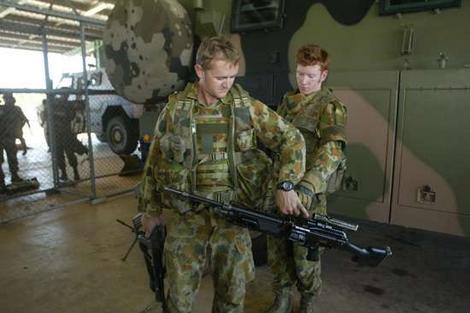
But the Australian navy's three largest ships, HMAS Kanimbla, HMAS Manoora and HMAS Tobruk, will load Darwin-based armoured personnel carriers (APCs) and hundreds of troops ahead of an expected United Nations request for military assistance. The peacekeeping task force will include more than 1000 personnel equipped to enforce law and order and evacuate civilians from the capital Dili.

It will include 450 infantry from the 1st and 2nd battalions of the Townsville-based 3rd Brigade and APCs from the Darwin-based 1st Brigade.

According to sources, the Government expects a UN request at any time. From the Sydney Daily Telegraph

And here is the word from the top: Prime Minister John Howard said the deployment was a sensible measure, but no request had been received from East Timor.

Leave the poor bastards alone to sort out their own transition from occupation to independence! Ramos-Horta is no idiot, either are the other leaders of East Timor. They know the local situation, the people and dynamics, better than John Howard or the UN ever could.

The people of East Timor sought help to extricate themselves from the oppressive and murderous occupation by Indonesia.

The East Timorese have earned their self determination and as a sovereign nation should be left to decide how they will handle difficulties of integrating various community groups, including former freedom fighters.

Disaffected elements of the military and gangs of youths led a riot in Dili recently, which left at least six people dead.

The violence was blamed on the dismissal of 600 soldiers in March, who had deserted the army over claims of discrimination.

More than two dozen retired Falintil guerilla fighters met to draft a declaration. It was signed and delivered by Lieutenant Gastao Salsinha, the leader of 591 soldiers sacked in February for deserting their posts amid claims of discrimination in the military.

The protest leaders are veterans of the guerilla war fought by the independence movement Fretilin against Indonesian rule from 1975 to 1999.

They allege that the military hierarchy has favoured ex-fighters from the eastern region of East Timor for promotions at their expense. They also claim that the police force is riddled with their former enemies—officers who worked for the Indonesian security forces before independence.

Ramos Horta says most of the 594 soldiers who were dismissed several weeks ago for alleged breaches of discipline were not involved in the violence.

The tangled plot of the Greatest Show on Earth


Oh it is all so confusing; the what’s hot and what’s not of the ‘Greatest show on Earth’. The anticipation, in the news and blogs, ebbs and flows wildly.
Today’s plot is so quickly dropped by another startling revelation. Little wonder Hollywood sticks to fantasy; this is all too convoluted for the average viewer.
To help sort the tangled plot out I started to create a ‘running sheet’, this first attempt a mish mash of leading players and plot points. It sort of lacks that “who killed JR? simplicity, but that could be the fault of the show itself. So here is the first draft:

Iran strike threats
Iraq
NSA domestic spying scandal
Plame affair: Rove potential indictment
Abramoff Delay et al
CIA: Hayden nomination – prostitution links – Dusty Foggo
White House staff shuffle
Immigration Reform Bill
Torture and prisoner abuse – Guantanamo Bay – Abu Ghraib
Bush approval ratings
Gas prices
Katrina fallout
Tax breaks for wealthy
E-Voting Security
Dick Cheney – Halliburton KBR
Katherine Harris
Regulating the internet
Religious Right
Then a bit of real entertainment: The Decider - A new animation by Mark Fiore


Time for sanity on Iran

Confrontational ... Mahmoud Ahmadinejad has vowed to reject UN measures against Iran's nuclear program. Photo: Reuters

The one thing that would galvanise Iranians behind their hardline President would be a strike by the West, writes Ed O'Loughlin in Tehran. Sydney Morning Herald


UPDATE

While Australian PM, Howard has been a willing accomplice in Bush’s military adventures, he might be facing a shortage of resources at the moment.

Deployments in Iraq, Afghanistan, Solomon Islands and now East Timor will severely limit Australia’s ability to play war games in Iran.

There are doubt about the country’s ability to play a role in the Sudan conflict, the sort of engagement their military is best suited for. The UN have requested helicopter support, which is stretched to the limit with current commitments.

Arguably Naval deployments in the Gulf region could be diverted to support an Iran conflict, as could ship earmarked for East Timor. Exactly what kind of support these would provide in the projected ‘quick, sharp’ air strike is a moot point.

Two thirds of Australians are opposed to involvement in Iran, but opposition has never stopped Howard. A run down from recent reports:

Australian Prime Minister John Howard said he would discuss Iran and relations with China when he meets U.S. President George W. Bush on May 16.
On Iran's nuclear program, Howard said he had given no thought to military involvement.

Australia has about 1,320 soldiers in Iraq as part of the U.S-led campaign, and 540 soldiers in Afghanistan. Two-thirds of Australians don't back the nation's involvement in the Iraq war, according to a Newspoll survey of 1,200 people published in the Australian newspaper on Dec. 31. BLOOMBERG

Three Australian navy ships have been ordered to strife-torn East Timor, and a fourth is on stand-by, as increasing unrest forced the UN to extend its mission in Dili by a month.

John Howard confirmed yesterday that two amphibious transport navy ships - Manoora and Kanimbla - had been deployed to waters off East Timor as a contingency measure.

A third vessel - the amphibious heavy-lift ship Tobruk - has joined the taskforce, while the missile frigate Adelaide is standing by in Darwin if needed.

The Prime Minister said the pre-positioning of the warships was required in case of a request for assistance from the East Timor Government, but none had been made so far. The AUSTRALIAN

The Australian Navy

Today's fleet consists of around 60 vessels including frigates, submarines, patrol boats and auxiliary ships. The RAN today is one of the most modern in the Pacific, tasked with the ability to defend the home waters, and undertake operations in farout locations. Current deployments of the navy include: contributions to the multinational force in Iraq; support for the United Nations mission in East Timor; and a "regional assistance mission" with New Zealand in the Solomon Islands. Wikipedia

AUSTRALIA'S capacity to commit troops to the planned peacekeeping force in war-torn Sudan has been questioned by UN ambassador Robert Hill.

The former defence minister said this could prevent Diggers being part of the 20,000-strong peacekeeping force the UN wants deployed in Sudan's western Darfur region by January.

The UN was "always after air transport and helicopters", he said, but warned that Australia would find it particularly difficult to meet any requests for its Blackhawk choppers. News.com.au

Note: some of you will be aware of my doubts about the eventuality of an Iran strike by Bush’s team. But those doubts are modified by other commentators; the ones who point out so clearly that these people, the Bush war mongers, aren’t likely to be held back by petty notions like logic.

The problem is it seems their agenda, as opposed to the rest of us, diverges wildly. We have allowed our leaders to have too much at stake to be concerned about the people on whose behalf they govern.


Yes, power does corrupt

Today’s NewsHound front page carries an unusual string of stories. No less than five current and former political leaders are cited in various scandals.
The US of course is bristling with news of President Bush’s bristling communication intercept network.
Still in the US, Kentucky Governor Fletcher has been indicted on ‘jobs for the boys’ issues.
Thailand has been sent back to the polls after the recent election was nullified. PM Thaksin is also facing an electoral fraud probe.
Former Indonesian strongman, Suharto has been given a reprieve from long running corruption charges. Age and mental health are cited as reasons.
South Africa’s former deputy president and head of the country’s AIDS council, Zuma, has apologized for having unprotected sex.
There are other ongoing dramas within the leadership ranks; NewsHound gathers all the political and corporate corruption issue from around the world. Issues are presented, fresh, daily in bite sized briefs.

Friday, May 12, 2006

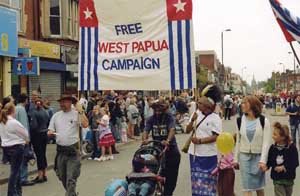
West Papua Colonial Shame

Australia’s record of assisting asylum seekers is a disgrace under the Howard Government, but no where near the disgrace of the country’s treatment of some of the regions former small colonies.

We have previously discussed the result of Australia’s meddling in the Solomon Islands in these pages. It is one thing to set a country on a course of self determination, another to hold on tight to the tiller.

East Timor is battling its own way through the process of an emerging nation, on its own now, thankfully. They would have been far more advanced in that task if Australia had not ignored their calls for self determination for so long.

The third arena Australia’s policies of self interest are a continual cause of consternation is West Papua – the western part of New Guinea now controlled by Indonesia.

It is the same the world over where ill-matching borders and cultures are forced, not for their own good, but for the good of the prevailing powers.

The West Papuans are not asking Australia to do battle on their behalf; they are simply looking for a relatively powerful regional ally who will support their rightful claim to independence.

Like East Timor, Australia was instrumental in the deal which put West Papua under Indonesian control. The reasons were and remain fairly simple; it is a costly exercise to aid the establishment and continuation of an economically small nation; far better to simply put them under the control of another willing power. Indonesia was not only willing, but to not cede these colonies to their care was to invite instability driven by tantrums and bully tactics.

Indonesia’s leadership are not unsophisticated in any sense, but their behavior on issues of hegemony creates the impression of insecure, bullying boofheads. I guess it works for them, bluff or not they have generally had their own way.

That leaves the disgrace of West Papua, a people poorly treated by their so called masters. There is no apology from Indonesia, no mea culpa, we will do better. The fact is, they see the Melanesian people of the country as stone age heathens; and we allow them to.

Australia now goes one better, so as not lose their lofty position on the abuse of human rights ladder. Having tried their hardest to turn back West Papuan asylum seekers before they reached the mainland, and failed because their actions were deemed as unlawful, the government is now trying to rewrite the law.

Controversial migration laws have just been introduced to the Federal parliament, and they are already causing division in the government parties.

Under proposed changes, all asylum seekers landing on the mainland will be sent to offshore detention centres in Nauru or Papua New Guinea's Manus Island to be processed. Anywhere but Australian soil.

Human rights advocate and Independent Council for Refugee Advocacy spokeswoman Marion Le said, "It's all very scary - no democracy should be setting this legislation, it's a really serious step backwards into darkness."

It is understood that at least five government MPs spoke against the legislation at a party room meeting this week, with one member opposed outright to the changes.

Prime Minister Howard said this week he was happy to discuss the new laws with concerned backbenchers, he did not commit to changing the bill and said it would not be withdrawn.

Immigration Minister Amanda Vanstone is standing firm on the changes, saying the government will not allow Australia's border protection policies to be undermined.

Immigration parliamentary secretary Andrew Robb, who introduced the legislation into the house today, said the new laws complied with the Refugees Convention.

"The Convention ... does not establish an entitlement for asylum seekers to choose the country in which their claims will be assessed or in which protection will be provided," he said.

No, but conscience and concern for the rights of people everywhere should not need to be enshrined in law, it should be simple duty.

More information on West Papua:

West Papua Action - Home Page

Papua Press Agency

West Papua Information Kit

FREE WEST PAPUA MOVEMENT There are many more sources on the web.

US exporting hate

What Sort of (Hated) Nation Have We Become?
Writer, Stan Moore, put the question in a piece (linked above) of the American nation. But reading his thought provoking piece strikes a sharp note with the antics of other coalition member countries.
“Imagine having to put a bank of supercomputers to work analyzing all of the electronic, internet, and telephone message traffic in the entire world in order to intercept communications in a world full of enemies and potential enemies. Apparently, this is the sort of nation the U.S. has become, or intends to become.”
For all the fantasy generated by the industry, there is no credible TV or movie producer who would dare stretch out credulity with a script approaching the reality of the US political drama. Billed as ‘the biggest data base on Earth’, the electronic surveillance scandal dogging the white House is still battling to gain traction among the myriad of other scandals on the go.
Still, the majority of them have one thing in common; that is the contempt that the ruling powers hold for ordinary American citizens. The many abuses of trust and authority, pushing up for light and air, demonstrate nothing less than a betrayal of the people.
The US government not only invites ‘hate’ from the outside, they seem determined to generate division and tension within their own country. Sadly, this lamentable example has been taken up all too readily by lesser powers within the US sphere of influence.
The alleged Bush agenda of seeding ‘US style’ democracy in world trouble spots is, it seems, succeeding beyond his dreams. That is not the democracy you might desire, but one close to the autocratic rule more common to the old Soviet.
He has been so successful that even once peaceful and pleasant countries like Australia, Britain and Italy have become embroiled in the ‘collateral’ fallout from the dubious war on terrorism.
The Blair government in Britain has their own set of nasty, crippling corruption scandals. Despite the popular opposition to involvement in the Bush adventure, Blair used his dominating position to push ahead anyway. Besotted by his proximity to ‘real power’ Blair readily adopted Bush’s bully style government.
The latest episode of the Blair scandals reveals that despite putting in place draconian anti-terrorism laws, his government never saw fit to provide the resources needed to police them. These laws were socially divisive, and a ready trigger for malcontents to adopt ‘the cause’ as an excuse to cause havoc.
That succeeded dramatically when home grown malcontents created devastation in the London bombings. Now two key pieces of intelligence have surfaced from these circumstances.1/ The London bombers had no outside guidance; they were stand alone groups.2/ Authorities charged with the job of stopping these types of incidents were not give sufficient resources to do their jobs.
Similarly, in Australia, the Howard government imposed it’s own, unnecessary set of anti-terrorism laws. It is true that Australian authorities have probably averted incidents similar to those in Britain, incidents incited by these hateful laws. It is also true that not one provision of the draconian Australian laws has been used in the process.
Bush’s agenda has promoted the dangerous hate targeting his country; there is little doubt about that. He has spread the insecurity to allied countries, whose leaderships were only too willing to join in the game. But worse still, all of them have created disunity, distrust and hate within their own communities.
A great example George! One for which the world won’t be thanking you.
Also posted on: Pundit’s Blog

Because I can

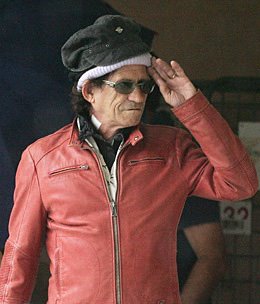
Corruption and stupidity generally travel in pairs. For the perennial rock star Keith Richards it was just the latter part of the equation.

Hardly the picture of youthful exuberance, I can still identify with the lure of a tree to climb. For Richards it was nearly his last.

Following another sell out tour of Australia, Stones – Richards and Ronnie Woods were kicking back and monkeying about on a Pacific Island.

Having shimmied the 10 meters up a coconut palm, Richards lost his grip and fell, landing on his head.

He was rushed to a New Zealand hospital, where his NY publicist claimed he was having minor treatment for the incident. Not so minor, as it turned out, with some pretty complex neurosurgery involved.

The good news, (see the pic) is that Richards will rock again. At least it was his head and not his amazing fingers.

As Richards likes to say: "Good to be here, good to be anywhere."

So no apology for being off topic, and fan pieces aren't about to feature regularly. But there you have it, the great thing about blogging is the freedon to go out on a limb occasionally; get off the main agenda and celebrate the quirks of humanity.

Thursday, May 11, 2006

Shame of Guantanamo Bay

Britain's attorney-general says The United States prison camp at Guantanamo Bay is a discredit to the American tradition of freedom and should close.
Lord Goldsmith called the Guantanamo camp's existence "unacceptable," the strongest condemnation of the prison by a British government official.

Only 10 of the current 490 detainees at Guantanamo have been charged with war crimes.
One of those is former Adelaide man David Hicks, who is still battling the British government to receive UK citizenship in a bid for release from detention.
The Australian government has steadfastly refuse to intervene on behalf of Hicks, which led to his move for British recognition.

Goldsmith said: "It is time, in my view, that is should close. Not only would it, in my personal opinion, be right to close Guantanamo as a matter of principle, I believe it would also help to remove what has become a symbol to many - right or wrong - of injustice."
He added, “The historic tradition of the United States as a beacon of freedom, liberty and of justice deserves the removal of this symbol.”

Views within the government tend, at least to some degree, along the Goldsmith lines.
Prime Minister Tony Blair has described the camp's continued existence as an 'anomaly' but has never demanded it be shut down.
Northern Ireland Secretary Peter Hain has said, when queried on the issu: "I would prefer it was closed, yes."
Foreign Office minister Kim Howells said in March that the camp should close if it was thought to be undermining the cause of democracy.
Four British citizens released from the US prison camp have won the right to sue their captors for violation of their religious rights.

The four - Asif Iqbal, Rhuhel Ahmed and Shafiq Rasul from Tipton, in the West Midlands, and Jamal al-Harith, from Manchester - have spent the past two years pursuing a wide array of complaints against the Pentagon and their military captors, including allegations of physical and mental abuse as well as affronts to their Muslim faith. This, though, marked the first time that a significant legal decision has gone in their favour.

Unlike their British counterparts, the Australian government has consistently toed the Bush administration line on the camp.
Prime Minister John Howard has brushed off Britain's strongest criticism of the US military prison in Cuba, saying Australia will go its own way in the handling of terrorist suspect David Hicks.
Australia's Attorney-General, Philip Ruddock, says his British counterpart is entitled to make his personal views known about Guantanamo Bay.
But Ruddock says the Australian Government believes the military commission at the detention centre is capable of delivering a fair outcome.
Ruddock and Foreign Minister Alexander Downer revealed Australia had signed an understanding for the transfer of prisoners sentenced under the US military commission process.
Under the agreement, Hicks would have to serve the full term of his US-imposed sentence in Australia.
However doubts have been expressed over the legality of the agreement. Hicks’ father posed the key question: How could his son be imprisoned in Australia if he was guilty of no crime under Australian law?
Hicks, 30, was captured with Taliban fighters in Afghanistan in December, 2001. He has been held at the Guantanamo Bay detention facility in Cuba since January, 2002.
He faces charges before a US military commission of conspiracy to commit war crimes, attempted murder and aiding the enemy.
Terry Hicks said his son was still fighting to gain UK citizenship – but US officials had blocked British officials from visiting the Australian for a swearing-in ceremony.
Gaining UK citizenship remains the Adelaide man's best hope of being released as all British citizens have already been freed from Guantanamo Bay under a deal struck between Washington and London.

Slavery Abolition Commemoration Day


FRANCE: It is slavery abolition commemoration day in France today. This has made France the first former slave trader in the world to set aside a day to honour victims of its hideous legacy.

For almost 300 years, French traders captured and enslaved Africans on its Caribbean colonies. France was Europe's fourth largest slave trader after Portugal, England and Spain and transported about 1.25 million slaves.

France abolished slavery in 1794, after a successful revolt by slaves in the island colony of Haiti.

Story source: African News Dimensions

The above image is from US State Dept: Trafficking in Persons Report

Leaders On the nose

While there is little direct comparison between US, British and Australian systems, it is interesting to note relative standings in the polls. The one area which is comparable is that the governments of each of the three countries have staked their fortunes on variations of the neo-con mantras.
They are fiscally monetarist and internationally interventionist; true champions of global economics. A smart politician will quickly tell you that there is only one poll that counts, although, of the three leaders, Blair is clearly in deep water.

BRITAIN: Tony Blair ranks as the most unpopular, British, Labour prime minister since the 1960s, according to an opinion poll in London's Daily Telegraph newspaper.
Just 26 per cent of respondents to the poll said they were satisfied by Blair's performance, one percentage point down from where Harold Wilson stood in May 1968 after a devaluation of the pound sterling.
The survey also indicated that support for the main opposition Conservatives is running at 37 per cent, against 31 per cent for Labour and 17 per cent for the smaller Liberal Democrats. Britain uses a first past the post voting method.

USA:  Disapproval of the war in Iraq appears to be driving the public's low opinion of President Bush's job performance, according to a CNN poll by Opinion Research Corp. released Monday.
The poll, based on interviews of 1,021 adults between Friday and Sunday, found Bush's approval rating was 34 percent -- an uptick of 2 percentage points from the most recent CNN poll in late April.
The president's disapproval rating was 58 percent, down 2 points from the previous poll. Both shifts are within the poll's sampling error of plus or minus 3 percentage points.

AUSTRALIA: Labor has now moved ahead of the Coalition by 51 per cent to 49 per cent in two-party-preferred terms. PM, Howard's rating as preferred prime minister fell by seven percentage points to 49 per cent; his disapproval rating leapt by nine points to 44 per cent.
Opposition Labor leader, Beazely’s approval rating continued to drop and at 30 per cent is his lowest ever as Opposition leader.
The Coalition's primary vote has remained steady at 43 per cent, while Labor's has risen by one point to 38 per cent - the same level reached at the 2004 election, which Labor lost.

Wednesday, May 10, 2006

Libertarian curiosities

Having been attacked, for being an outsider who dares speak about US politics, by a guy calling himself a Libertarian, I thought it might be instructive to have a look at what they stand for.

The ability of a human to hold totally conflicting belief is not unusual; to elevate them to a philosophical position is a worry.
Not that the basic, stated beliefs of the Libertarians suggest that. More it is the intolerance of people who would:
  • Demand freedom of belief and action for themselves but deny it for others.

  • Deny the collective responsibility yet insist in allegiance to the nation.

  • Fight for the right to free speech, unless it opposes their view.

  • Abhor crime yet demand the right to carry guns.

  • Support the repeal of taxation and then end of poverty by advocating a $1 for $1 tax credit for contributions to private charity.

  • Opposes censorship of online communications, again apparently, where it doesn’t offend them personally.

There is more, but let’s plough on here.

Another strange dichotomy is that these avowed individualists also have a political party, albeit one under constant stress.
It is one of the largest consistent third parties in the United States, with over 200,000 registered voters and over 600 people in office, including mayors, county executives, county council members, school boards and other local offices.
The great internal battle for these advocates of private property, are members of the leadership who it seems treat the party like private property.
I note the party is just a touch sarcastic about ‘lone wolf’ libertarians, who often claim there are no fellow libertarians in the area to join with. So daring to be an individualistic libertarian doesn’t go down well in the party’s view.

I would have thought that those who advocate maximizing individual rights and minimizing the role of the state might also be a little wary of a party organization – a mini-state in itself.

I was also amused by my anonymous critic’s assertion that: “Libertarians tend to favor policies of isolationism and we're generally against America's "big stick" policies that have raged on far too long.”
I don’t have any great problem with that, except that it would be far more effective to take the issue up with the US government than it is to attack me.  Said attack came in the same post: “Be advised that the anonymous poster is a staunch Libertarian and feels that anyone outside of his own country doesn't have the room to criticize simply because you do not contribute to the good of my nation whatsoever.”
Ahhh, anonymous, you would be surprised.
So for anonymous and those Libertarians wanting to attack me for holding forth on the country whose rules they seem to despise, I offer you the following:
“We Libertarians base our political philosophy and our solutions to today's problems on a single principle: You have the right to live your life and use your property as you see fit, just so long as you respect the full right of others to do the same.”
And I shall continue to do just that.

‘Oil for Food’ world roundup

It’s time for another ‘Oil for Food’ world roundup.
Prompting this update was an encouraging sign that some in the US are lamenting the lack of general interest in the scandal: News Media Still Yawning Over Rampant UN Corruption
“A large part of the media's failure to report on the UN malfeasance is that it is such a complicated case of fraud, duplicity and mendacity that reporters find themselves incapable of dumbing down the story for human consumption.”
That should make a few of the lesser nations of the world feel good about themselves; those who can actually understand and face the complexities of this issue.

TURKEY:
Turkish State Minister Kursad Tuzmen on Tuesday denied allegations that he helped some companies earn money illegally from the oil-for-food program with Iraq. "What I did was in line with our laws and regulations," he said at a news conference in Ankara.
The allegations center on the time Tuzmen was undersecretary of foreign trade in the late 1990s. The minister said all his actions were known to the government.
The comments follow a report in the Milliyet newspaper that the Prime Minister's Office had launched an investigation into allegations by the parliamentary Investigation Committee on Fuel Smuggling that Tuzmen helped four companies, Oz Ortadogu, Ram Dis Ticaret, Tekfen, and the partly government-owned TPIC, reap $123 million in unfair profits by issuing them permits to import 2.7 million tons of crude oil.


SOUTH AFRICA:
The Democratic Alliance has urged President Thabo Mbeki to broaden the Donen Commission's terms of reference to include a probe into allegations of African National Congress involvement in the Iraqi oil-for-food scandal.
The Freedom Front Plus also wants the commission's terms of reference extended.
At the moment, the terms precluded the commission from investigating the role played by senior ANC members in aiding and abetting South African-owned companies from securing oil contracts from Saddam Hussein's regime, as it had been restricted to investigating only whether kickbacks or surcharges were paid.
There is growing documentary evidence, according to the Mail and Guardian newspaper, which appeared to prove that Majali had extensive political connections, both within the ANC and the government, and that these could be used to influence the Iraqi government in an attempt to secure oil contracts.


USA:
Lawyers for Texas oilman Oscar S. Wyatt Jr. argue in court papers filed Monday that conspiracy charges against him should be dropped because they were brought only in retaliation for his being "a persistent and vocal critic of U.S. policy."
Wyatt, the founder and former chairman of Coastal Corp., has pleaded not guilty to charges that he conspired to pay millions in kickbacks to Saddam Hussein's regime in Iraq to win contracts in the United Nations' oil-for-food program.
Charges against Wyatt must be dismissed because they were brought vindictively, Wyatt's lawyers say in papers filed in U.S. District Court in Manhattan.
The lawyers argued Wyatt had demonstrated that a large class of similarly situated people and more than 2,000 companies that paid surcharges to the Iraqi government had escaped prosecution.


AUSTRALIA:
Prime Minister John Howard expects to receive the final report from AWB oil-for-food inquiry commissioner Terence Cole on June 30.
However, Howard has told a joint party meeting he has nothing more to add on the issue until he received the report.
"There was nothing really to be added until Cole has reported," a party spokesman said.
Cole heads the commission of inquiry into $300 million in kickbacks the Australian Wheat Board (AWB) paid to dictator Saddam Hussein's regime.


INDIA:
The probe into the Saddam Hussein oil-for-food payoffs against former external affairs minister Natwar Singh and Congress has reached a final stage with the Enforcement Directorate (ED) having received confessional statement from Andleeb Sehgal that he received $67,000 of the total $1,50,000 commission.
The money, paid to Indian beneficiaries of the scam, has also been traced to Aditya Khanna, who has also allegedly confessed to ED that he received a part of the payoffs. Both Khanna and Sehgal are relatives of Natwar Singh who along with his son Jagat is under investigation and had to quit as external affairs minister when the scam broke.
A total of $150,000 (about Rs 75 lakh) was paid by Swiss firm Masefield to Indian beneficiaries. Sehgal has reportedly agreed that the $67,000 (around Rs 34 lakh) he received as proceeds of the oil deal from Masefield was routed through banking channels to India.


BRITAIN:
Weir Group's involvement in the "cash for contracts" scandal in Iraq will continue to cast its shadow for "quite some time to come", the Glasgow-based company's chief executive Mark Selway recently admitted.
Despite that Britain has taken very little action on companies and individuals named in the Volker report.
In fact the British government has been accused of frustrating the Australian Cole inquiry's attempts to quiz a former United Nations customs chief who alerted Australian officials to the AWB kickbacks scandal.


PAKISTAN:
Pakistan’s anti-corruption bureau has alleged former Prime Minister Benazir Bhutto’s involvement in the United Nations oil-for-food scandal in Iraq.
“Bhutto gave a two million commission to the regime of Saddam Hussein to win contracts worth 115 million dollars through two Sharjah-based companies she registered in 2000 and 2001,” Hassan Waseem Afzal, Chairman of the The National Accountability Bureau (NAB) alleged.
Bhutto’s spokesman, Faratullah Babar rejected the allegations saying it was part of Pakistan government’s smear campaign against Bhutto, who headed the opposition Pakistan Peoples Party, (PPP) from her self exile in Dubai.


Regular updates are posted at NewsHound Oil for Food

Foxy Murdoch aims for power


RUPERT MURDOCH, the most powerful media mogul in America, has decided he wants to help get Hillary Clinton elected.

Murdoch, whose media outlets included Fox News and the New York Post hounded President Bill Clinton when he was in office and have attacked his wife since before she was elected a senator in 2000, has decided to host a political fund-raiser for her on behalf of News Corporation, according to the Financial Times.

Now there is a reason to fear the elevation of former ‘First Lady’ to President. I occasionally note the incredible influence Murdoch seeks to impose on US politics. Talk about the tail wagging the dog!

Money and greed aren't faith

Mike at Born at the Crest of the Wave posted a very thought provoking piece today:
Babies die because their parents are poor.
The summary comment was - You cannot base public policy on "faith." It's time we all grow up.
You cannot base public policy on "faith."
I'm inclined to think the faith aspect is merely a cover for the money factor. Any reasonable offshoot of Christian/Judaic faith or Islam for that matter, puts caring first.

It's time we all grow up.
That is the real point. The monetarist policies which are the backbone of the ‘faith’ are little more than a society trapped in pre-adolescent yearnings for security.
In adults it becomes pure grasping greed, which has translated itself into dominant social institutions like government and religion.

Ironically, perhaps, this greed is the antithesis of faith, which would allow us to let go of the insecurity and look to the real needs of society.

There is a built in survival mechanism for, essentially, helpless young humans. It is effectively based on a ‘me first’ demand.

But society is not growing out of that infantile phase, and instead the young, who are still helpless, are left behind. It is a sick commentary, but it isn’t universal.


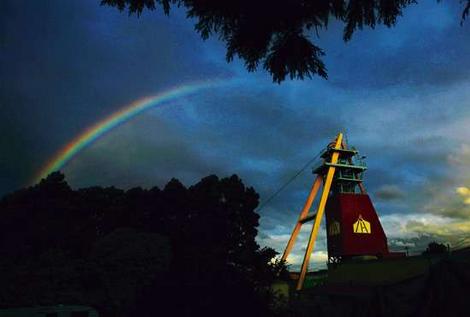
I am still reeling from the most incredibly display of selfless community coming out of the Tasmanian mine rescue. The people of the small town of Beaconsfield Tasmania has shown a very real example of how this world can really work properly.
See: Mine Rescue – amazing scenes Miners free at last below.
Not that those involved were universally wonderful.
A few, but just a few, reporters made arses of themselves.
But on the whole the two weeks of drama showed up a truly remarkable effort of co-operation and unabashed focus on what rally mattered, the lives of two men trapped nearly one kilometer underground.
Even the local Uniting Church minister showed her humanity along with her religion.
Working in a tough mining town she can cuss with the best of them, but she never forgot once that she was working as an instrument of her ‘God’. That is faith!
The picture is of one of the miners just hours after rescue attending the funeral of fellow miner, Larry Knight (inset) who died in the mine collapse.

Tuesday, May 09, 2006

Mine Rescue – amazing scenes


Brant Webb leaving the Beaconsfield mine in an ambulance.


We couldn’t see what was happening at the mine head, just listen to the radio reports. They described two men, trapped underground for 14 days, walking unaided from the mine lift thrusting their arms into the air.

When we did get visuals it was of the ambulances the men were reluctantly put into, their doors wide open as the paraded out the gates past well wishers.

Medics had to wait until the pair were out of site of the waiting crowd Brant Webb and Todd Russell were focused was on greeting all those waiting for them.

The miners were rushed to hospital for full health checks, but were confidant of being back in Beaconsfield for bacon and eggs.

On a sobering note, the men were free in time to attend the funeral of co-worker Larry Knight who died in the initial rock fall.

Knight’s family held off farewelling Larry until the pair were freed from the mine, but finally set it for today.

The roller coaster emotions in Northern Tasmania are set to continue for some time, as the town comes to terms with the many dramas witnessed over the past few weeks.

Ironically, the Beaconsfield opened up to media who inundated by town to cover the story. Initially, locals were simply being good hosts, providing home cooked meals among other things. After the death of leading media personality, Richard Carleton as he was covering the story, the grieving town became comforters to the shaken reporters.

As an example of positive community spirit which cannot be beaten. In both their joy and in the grief our hearts should all be with the people of Beaconsfield.

Miners free at last

The news we have been waiting for:

Todd Russell and Brant Webb have been rescued from the Beaconsfield mine in northern Tasmania.

News just in says the men were freed from the mine just before 5:00am AEST, since being underground since Anzac Day.

The men will be brought to the surface during the morning.

After 14 days trapped nearly a kilometer underground the pair have shown remarkable resilience and good humour. They have said they were aware of attempts to rescue them from the start, as they could hear some of the search effort.

At the last, once freed from their underground cell, the pair delayed their re-emergence so they could shower first. Above ground Beaconsfield came alive to the sound of the town’s church bells. The bells have not been heard since the end of the Second World War.

Early reports say the men are in remarkable good health after their ordeal.

Some of the background stories:

It's up to their family and friends

TRAUMA experts have advised against swamping the newly rescued Beaconsfield miners with counsellors. They say the support of family, friends and their close-knit community will be the best mental salve for Brant Webb and Todd Russell.

Meet me for a beer later, says Foo Grohl

BEN CUBBY | THEIR tiny steel cage is not much of a mosh pit, but the post-grunge groove of the Foo Fighters has helped Brant Webb and Todd Russell through some of the hairier moments of their entombment.

Into the light

Finding two men alive in the collapsed mine was one thing. Getting them out has been another. Gary Tippet reports.

Mate's farewell

Mine accident victim Larry Knight may be buried todah without a farewell from his two workmates.

What's on their minds?

Deep, deep underground, in the cramped humid cage that has been their prison for 13 days, the miners reel from disbelief to anger, from jubilation to despair.


Not the America I know

I don’t normally respond to anonymous posts, and even less commonly devote a post to them.
I realize and accept non-blogger commenters can and do respond with intelligent comment.

But given the tendency for hit and run attacks under the cover of anonymity, and the growing trend for those annoying spam messages, they are more commonly just rubbish.

I expect the recent post on Time no friend of Bush was meant to be a serious comment, despite its poorly framed argument:

Anonymous said...

I have to admit, there is nothing more interesting than seeing a canadian post comments on our president Bush.

Except for one thing: watching the mold grow on open bread, or how about counting how many blades of grass there are on my front yard.

I guess the message means – ‘mind your own bloody business and leave the US alone.’ That I’m not a Canadian, (small c or otherwise) is perhaps not relevant, but I guess I feel the need to proclaim my Australian heritage.

That my country of birth and my country of current residence; should somehow render my observations irrelevant smacks, of a paternalistic ignorance which is thankfully not common in the blogging community.

If the commenter had found my reflections boring, in the normal course of things, they would have simply moved on. But there was obviously a point to be made, or attempted.

While there are no doubt many Americans who would rather the country was fully insular, or alternatively engage in bully tactics to fend of criticism, the reality is different.

The USA is an active member of the world community; a member with enormous influence over the politics and economics of other countries; including Australia and Canada.

While I can understand the tendency to want to defend national pride, the purpose is not served with smartarse comments.

For my part I am will comment freely and fairly on events and personalities anywhere. Hopefully it is a dialogue, in the end, and I’m always ready to stand corrected when shown to be wrong.

But please, let us not degenerate into a stupid cross border shit fight.

Post under anonymous or any other handle, but please do not insult your fellow countrymen or the rest of the world with shallow insults in place of considered discussion.

Zuma judged not guilty

A south African judge yesterday acquitted former Deputy president Jacob Zuma on charges he raped an HIV-positive family friend, keeping alive the political hopes of a man until recently seen as the country's next president.
Zuma's rape trial has fanned tensions in the ruling African National Congress, where he remains a widely popular figure and was until recently seen as the frontrunner to succeed President Thabo Mbeki in 2009.
Justice van der Merwe, who under South Africa's non-jury trial system decided the case, said the state had failed to prove beyond a reasonable doubt that Zuma had intended rape, and questioned the credibility of the complainant.
"It would be foolish for any man with a police guard at hand and his daughter not far away to surprise a sleeping woman and to start raping her without knowing whether she would shout the roof off," he said.
Zuma, an ethnic Zulu, was hit with the rape charge following a separate graft scandal last year which prompted Mbeki to sack him as the country's second-highest official.
Political analysts said the rape case had done serious political damage to Zuma, particularly because he conceded that he had unprotected sex with the woman despite knowing that she was infected with HIV.

Come clean on troop deployment


FAMILIES of soldiers serving with the special forces task group in Afghanistan have told of their frustration at the lack of information the Government is releasing about their sons' perilous mission, warning that the public is underprepared for likely casualties. Sydney Morning Herald
The concerns, expressed to the Herald by a number of parents, came as the Prime Minister, John Howard, announced the final composition of the 240-strong reconstruction taskforce Australia will send in July to the dangerous southern Afghanistan province of Oruzgan.

Australia has fared extremely well with its deployments to Iraq and Afghanistan. With over 4000 troops in foreign hot spots, the accidental death of Jake Kovco, in Iraq, marked the first Australian casualty in Iraq. Four members of Australia's special forces were recently wounded in Afghanistan.
The low casualty rates probably reflect the relatively small deployment of the cream of the country’s offence force. Each new deployment must increase the risks, as does the stepping up of Taliban backed attacks in Southern Afghanistan.
But the Howard government, as they do in most other spheres of their decision making, is cloaking the deployments in secrecy. It is facile to claim security reasons; facile to think that the Taliban and their allies don’t know most of the details of deployments on their patch.
The issue really concerning many of us is the Howard government’s demonstrable incompetence. This was put on display for us with the circus surrounding Kovco’s death. They couldn’t even escort the right body home, for God’s sake!
The secrecy is more about potential domestic crisis management then it is about security. The more they play this secrecy game the greater the crisis they seem to be able to generate for themselves.
Families and the country as a whole, have a right to know where our military personnel are deployed, and why, and what are the potential consequences of our meddling on foreign soil. There is little so far to give confidence to any thoughts of positive long term outcomes.

Monday, May 08, 2006

Time no friend of Bush

Scandal and corruption follows total legislative control as night follows day. Without effective brakes on their administrations an ‘anything goes’ because ‘we are not answerable’ mindset is all too common.
The governments of the ‘anti-terror’ coalition all have (had) one thing in common; they had the numbers to totally control their respective political environments.
The ‘had’, in parenthesis, signifies the first partner to fall, Italy’s Belusconi.
Facing down the inevitable scandals of their administrations has meant developing a set of effective strategies. In the main, given the overall bulldozer tactics, time has been a convenient cure for even the worst excess.
Stall, deny, obfuscate and wait for another diversion to sweep it from the public eye and mind.
The Bush administration obviously had this ‘crisis management’ technique in mind, explain nothing, just do it and let time heal the wounds; when confronted with the Goss issue.
But like Belusconi, like Britain’s Blair and Australia’s Howard, time has allowed too many unresolved issues build and intertwine, the tactic is now falling apart.
Whatever happened behind closed doors, whatever the arrangements and accommodations, when Goss emerged to verbally reinforce the ‘mystery’ of his departure there were simply too many potential scenarios to allow the matter to pass quietly.
The Bush regime is now trapped in a mess of scandals from which time no longer offers escape. The next diversion will be, more than likely, another running story line from the great White House soap opera.
The best clue is the story in Capitol Hill Blue: "The lawyer for former White House aide Lewis "Scooter" Libby said on Friday he would argue that his client revealed intelligence on Iraq after Vice President Dick Cheney authorized it and President George W. Bush declassified the information."
But if not the Plame affair there is still a wealth of other candidates to keep the Bush show in the limelight.
Bush’s partners, all apparently reading from the same script, are finding they are in the same predicament. By not addressing various ethical failures as they arise, by letting time deal with them, they have allowed a mass of unresolved issues to slowly swamp them.
Even worse, for them, almost any questionable issue now takes on a major importance. These governments have been living in a fools paradise and as we say in Australia, ‘the chooks (chickens) are now coming home to roost.’

Hard news from mine rescue

The upbeat mood in the small mining town of Beaconsfield, Tasmania, took a dive after a double whammy.


First up was the news that the rescue of two miners, trapped nearly a kilometer underground, was being slowed down by a wall of nearly impenetrable rock.


As the latest rescue difficulties were being absorbed, news of the death of Australia’s much loved TV journalist, Richard Carleton had died at the scene, from an apparent heart attack.


On the rescue effort:
LIVE WEB CAM of the rescue site.
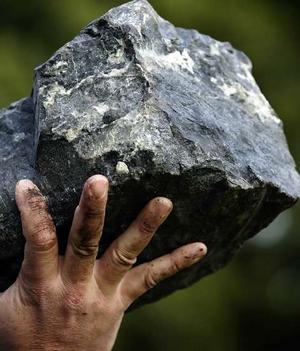
Retired Launceston geologist, Douglas Ewington, explains the nature of the rock which is presenting such a formidable barrier to rescuers. Ewington identified the rock as Quartzite (see picture).


"Quartzite is an extremely hard rock which started as sandstone about 500 million years ago."The dark grey sandstone has metamorphisised, or cooked, to gain its current hardness.

"It has been compressed and chromatic oxide has cemented the original grains together.

"The depth of the rock led to it being unweathered, or softened, by the elements, he explained.

"The geology of the area is extremely complicated, I'm not surprised there have been problems down there.

"Ewington said that it was in such rock that gold was commonly found as it welled up from deeper within the Earth's surface.


Richard Carleton
For those wanting to know more about the life of a truly effective TV news and current affairs broadcaster, try his home NETWORK. Richard Carleton’s death has been a shock to all across Australia, but his memory will be treasured.
He was one of a team who kept real news in the forefront on commercial television in Australia.
Thank you Richard, for setting such a great example.

Sunday, May 07, 2006

Spying is such a hard life

For no other reason than I found it amusing:
The Czech Republic's spy chief is set to appear at a public ceremony on Monday disguised beneath long hair and a beard to conceal his true appearance so he can keep working in undercover operations.
The Dnes newspaper says Colonel Karel Randak has decided to let his hair grow out so he will remain unrecognisable even during a televised ceremony at Prague Castle, in which President Vaclav Klaus will promote him to general.
Col Randak is quoted as saying, "I would have preferred to have remained a colonel".
The newspaper says Col Randak is understood to have personally taken part in undercover operations against arms and drugs traffickers and has access to confidential CIA data.
Czech chief spy dons television disguise

Saturday, May 06, 2006

A simple airline stub reveals all

British journalist, Steve Boggan, picked up a BA stub, mindful of a conversation I had had with a computer security expert two months earlier, from a waste bin on the Heathrow Express to Paddington station, London.
The expert had told Boggan how that tiny stub would give access to all its former owner’s personal details. The owner’s name was right there on the stub, along with the flight and seat number.
With just those scant details Boggan was easily able to access the former owner’s personal information, including his passport number, date of birth and nationality.
It also had potential to provide the building blocks for stealing his identity, ruining his future travel plans - and even allow me to fake his passport.
Boggan also said it “would also serve as the perfect tool for demonstrating the chaotic collection, storage and security of personal information gathered as a result of America's near-fanatical desire to collect data on travellers flying to the US - and raise serious questions about the sort of problems we can expect when ID cards are introduced in Britain in 2008.”
Stub in hand, Boggan logged onto the BA website “bought a ticket in name on the stub and then, using the frequent flyer number on his boarding pass stub, without typing in a password, were given full access to all his personal details - including his passport number, the date it expired, his nationality (he is Dutch, living in the UK) and his date of birth. The system even allowed us to change the information.”
“Using this information and surfing publicly available databases, we were able - within 15 minutes - to find out where the former owner lived, who lived there with him, where he worked, which universities he had attended and even how much his house was worth when he bought it two years ago.’

Boggan makes an interesting case against the US system called CAPPS, which screens travelers intending to enter the States. “"If you are an American who has volunteered lots of details proving that you are who you say you are, that you have a stable home, live in a community, aren't a criminal, [Capps II] will flag you up as green and you will be automatically allowed on to your flight…"
You can pick up the whole story from the Guardian: Q. What could a boarding pass tell an identity fraudster about you? A. Way too much

Pain in Paradise

Two Solomon Islands politicians held in jail on charges of inciting last month's riots have been appointed ministers - one in charge of police and security and the other looking after tourism.

The new Prime Minister Manasseh Sogavare, replacing the short lived reign of Snyder Rini, has appointed Charles Dausabea to the police and national security portfolio even though he is accused of being a ringleader in the April 18-19 riots.

Dausabea and Ne'e cast their votes from inside Honiara's Rove Prison after a court denied them bail. It was unclear where they would take their oaths of office.

Australia has warned the new Solomon Islands Prime Minister that there will be damaging repercussions over his appointment to cabinet of the two MPs.

An Australian foreign Affairs spokesperson says the special coordinator of the regional assistance mission, James Batley, has been asked to make representations to the government expressing Australia's view; that the appointment to cabinet of individuals facing serious criminal charges will have damaging repercussions for the standing of Solomons Islands in both the regional Pacific community and wider internationally.

Read more…

Is the political pendulum set to swing?

…IMF-World Bank Crisis Deepens

Washington, DC, April 24. The spring meetings of the World Bank and International Monetary Fund took place this weekend with police barricades ringing the two institutions at the heart of Washington, DC. There were almost no protesters in sight.

There is a strong argument, which crops up from time to time, that there should be fewer lawyers and more historians among the ranks of lawmakers.

The reasoning is that societies go through severe cycles, as history will clearly demonstrate, unless we are able to learn from the past to moderate the excessive swings.

There are indications that we are getting close to the top of one of those severe swings, that the monetarist policies of the past few decades are reaching the end of their life. Indications that this so called economics, which is little more than a license for greed, is under stress come from more than this one story.

Recent reports out of Japan say that voters there are set to reject that country’s experiment with monetarist policies. While the approach no-doubt pulled them out of the Asian melt-down mess, voters are simply not willing to bare the hardships imposed by the approach.

Italy’s return to a left wing government, after the excesses of the Berlusconi government marks another chip dislodged from the powerful economic megalith.

The US and their coalition partners are under intensifying pressures from scandal related to the neo-authoritarianism which has become closely related to monetarist policy. The premise on which these countries justified an obvious ‘resource’ war has now clearly been revealed as based on lies.

But that is not the issue which is slowly sinking them. The real issues dogging them are more home grown and related to the incompetence and greed which seem to go hand in hand with unchallenged power.

From the historical view it is time for the pendulum to start swinging back. The frightening part is, without appropriate moderation, a governor on the engine of state, the pendulum will invariably reach the opposite and equally repugnant arc of its swing.

It seems to be human nature to toss out the baby with the bathwater, at least on the larger social scale of things. Invariably we the voters, given so little choice in the matter, end up replacing one extreme with another.

It would be refreshing, just for a while at least, to replace the political pharisees with a few jeremiahs. But then we the voters would need to face a few of the realities of social development and for most that is the job for someone else – the elected representatives.

Until we, as societies, really start to engage with the political scene between elections we are doomed to be tossed about by the inevitable self interest of our chosen representatives.

Raised 'Voice of America'

Hecklers berated US Defence Secretary Donald Rumsfeld today during a stormy encounter with a former CIA analyst who accused him of lying his way into the Iraq war.

Rumsfeld, an unyielding defender of the war, denied lying.

From the Melbourne Age

You can tell it’s from the foreign press because defence is spelled properly.

Friday, May 05, 2006

White House secret documents passed on

A former US marine who worked at the White House has admitted passing "top secret" information to Philippine political figures to help in an attempt to overthrow the country’s government.

Filipino-American Leandro Aragoncillo admitted he met co-conspirators at the Malacanang presidential palace in Manila, in January 2001, the US Justice Department said.


The story has been around for a few months, I though it had been buried. But no, US prosecutors have obviously been getting their ducks in a row.
When it first broke, in the Philippines, accusations were directed at the White House for attempting to destabilize their government.
I don’t know that the average US Joe would even know where the country is, never mind be concerned at the Bush administration meddling in the politics of another country.

Tasmanian Mine Rescue

Having spent many years in Northern Tasmania, and fossicked around the goldmining town of Beaconsfield, the dramatic rescue mission is of intense interest to me.

I’m sure others are following progress keenly as well. There is a web cam at the mine head Just ignore the story around it and open the pop-up.

Some good sources on the story include:

Australian ABC

The Melbourne Age

Launceston Examiner

Skewed perceptions of corruption

India has improved its rankings in the global corruption perception index. It ranks 88 among the 158 countries in the latest Transparency International Corruption Perception Index and there is undoubtedly great room for improvement.

In comparison, Britain is the 11th least corrupt nation, Canada 14th and the US is at number 17. Australia ranked ninth among the 10 least corrupt countries.
Among the 158 countries, Pakistan lags at 144th position and Bangladesh is right at the bottom at 158th.

Balbir S. Sihag, a professor of economics at the University of Massachusetts who visits India twice a year, says that high economic growth, as is the case of India and China today, was prevalent with high corruption in Britain and the US before these countries emerged as major economic powers.

Both Britain and the US had very high degrees of corruption during the Industrial Revolution. Even today corruption - like the Enron and other corporate scandals - are very much evident.

‘In the West, they amend laws. In developing countries, they bend laws,’ says Sihag, citing million-dollar budgets and slush funds of lobby groups while in the poor countries it is plain corruption.

The Transparency International (TI) corruption perception index, for all its good intention, is a difficult beast to wholeheartedly adopt. It is, after all, merely a guide to perceptions of corruption, and does not measure corruption itself.

India is a regular source of corruption stories for NewsHound. In fact the whole of that region is rife with petty bribery, often referred to as tea money.

Professor Sihag raises the key issue, however. It is only corruption if it is proscribed by law, and it seems, viewed by voters as being an ethical violation.

It is an easy thing to change laws to legitimize questionable behavior; not only easy, but common, in many of the Western Democracies. The ability to sanitize unethical acts by rebadging and enshrining them in law them can be seen in a wide range of areas of public interest, from electoral law through to allowing perks for low level and low paid public servants.

Of greater concern is the ability of governments and their public sectors to ignore the law and rely on public opinion to cover their transgressions.

That can be seen at play in the US where voters are willing to overlook the Bush administration’s unlawful use of torture, rather than accept the awful reality of what is really happening. That is just one area where that particular administration is riding rough shod over the community.

In Australia, the Oil for Food scandal has exposed the Howard Government’s willingness to break laws in the name of international trade. For a while it seemed that voters in that country might overlook what was seen as a ‘necessary’ method of doing business.

Blair’s government in Britain received a rude shock when voters rebelled at the sale of honours to raise party election fighting funds.

Of course those three leaders got away clean from an even greater level of unethical behavior – prosecuting a war on what were clearly lies. But that sort of issue is a little beyond the understanding of the ordinary folk, it would seem.

The perception index really does face some difficulties. Canada comes in below Australia, at 14th position. Why? It is certainly not because the country is more prone to corruption than its Commonwealth sister.

My theory, and experience for that matter, is that Canadians are generally, genuinely decent folk who really take news of official corruption to heart. They don’t yell and scream about it, they are simply not that confronting, but they feel it.

Not like my Australian mob. So often, when I quizzed family and others about corruption in that country there is something close to relief, in finding government and public servants can be crooked. “Well if they can do it, its okay if I do it,” one explained to me.

With that attitude I’m only surprised that Australia does not appear as number one on the list, a country where corruption is happily perceived as business as usual.

It speaks… Cheney has a voice

THE US Vice-President, Dick Cheney, in one of the Bush Administration's sharpest rebukes to Moscow, accused Russia yesterday of backsliding on democracy and urged it to stop using energy supplies for "blackmail".

"Russia has a choice to make," Mr Cheney told Baltic and Black Sea leaders in Vilnius at a time of increasingly chilly relations between the US and Russia.


Good on old Dick. The problem is, of course, he is part of an administration which fails nearly every test of democracy and ethical behavior.

Of mice and men?

America seems a curiously inward looking society to many of us outsiders. When commentators do look outside it is more often to find examples of worse situations to shore up fading national pride. An article by Daniel Johnson in the New York Sun, Fading Leaders, is an example.

“It is some consolation for Americans who are dismayed by the drift and disarray of their own administration that things are even worse in Europe, most of whose governments are now squalid spectacles of chaos and corruption. The weakness of the Western response to Iran's threat to annihilate Israel is in part, at least, a reflection of the enfeebled state of the European political elite.”

The gist of the article, if you don’t want to go there, is a run-down of the current political ills

across Europe; a sort ‘see we aren’t so bad…’ Again, a curiously American (or even Republican perhaps) response of pointing to an alternative example of failure, in an effort lessen their own apparent failure.

Sorry Daniel, regardless of what is happening elsewhere, and there is plenty of it, the US variety is all home grown. Pointing to other failures does not extinguish responsibility.

Stange Flip Side

The article then does a flip, extolling a European achievement apparently outside the grasp of the US:

“So Europe is not a pretty sight. Yet there are still brave individuals who uphold the best traditions of Jewish and Christian civilization in this continent. One of them has just died at the age of 82: Jean-Francois Revel.
Revel was one of the minority of post-war intellectuals who did not betray the promise of the liberation of France.”

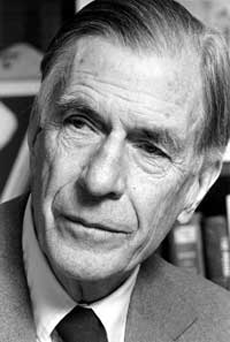
Uhmmmm North America’s version “of the minority of post-war intellectuals who did not betray the promise” died late last week. J K Galbraith (pictured) was a giant of a man, but of course central to his importance was an unyielding grip on ‘liberal’ values.
Galbraith, it is said, was the only economist of the 20th century to become a household name. He certainly stands as one of the last of the true economists. Unlike the current crop of monetarists, Galbraith held to the fact the economics must embrace social as well as fiscal well being.
He should have been revered equally with Rosa Parks and other great American reformers of the 20th century, but his passing seems to elicited more a sigh of relief than the high homage due.

My point is simple: It is pointless to simply keep pointing the finger elsewhere. Take responsibility for your country’s failings and celebrate its successes. The USA has so much to offer a world it seeks to control, but that can only be achieved by realistic self assessment.

Thursday, May 04, 2006

Wish I had said that

As the Bush/neo-con kleptocracy disintegrates in a toxic cloud of military defeat, economic bankruptcy, environmental disaster and escalating mega-scandal, its attack on basic American freedoms---its "New Totalitarianism"---has escalated to a desperate new level, including brutal Soviet-style prosecutions against non-violent dissidents and an all-out offensive for state secrecy, including an attack on the internet.

Now I do wish I had written that, but I was beaten by Bob Fitrakis and Harvey Wasserman in an article, one version of which can be found here: The "New Totalitarianism" now defines a desperate neo-con end game

Ahhh, that is better...

The blog was out of action for the best part of a day afer I attempted to import it to the NewsHound site. I guess it is a matter of a little knowldge. But we have restored everything now. Posings will resume as soon as my sanity stabilises.

Wednesday, May 03, 2006

Mad cows and gullible people

Issues like mad cow disease (BSE) and avian flu have a delightfully simple and frightening aspect to them, which tends to override to complexities of the reality.
General ignorance of the issues is a boon to regulators who are merely concerned with preserving markets, with health a secondary issue.
The fact is, the food authorities around the world know there is little risk of human contamination from normal farming practices.
The real risks, particularly with avian flu are things regulators and farmers can’t control, like the movement of disease carriers, wild birds.
Where outbreaks of these diseases have affected humans there is invariably close living conditions with humans and animals, and a mixture of animals at that.
The upshot, once the known risk factors like feed contamination are dealt with, is that much of the rest is simply window dressing for a gullible public.
There are, no doubt, still serious consequences if a human of strain bird flu gets out. But it is fairly slim, as the peasant farmers most susceptible aren’t exactly note travelers.
Even less of a concern is mad cow disease rampaging through the community. For a start the diseased tissue needs to be ingested, and in large quantities at that.
Even cattle cannot simple pass the disease from one to the other.
Unfortunately, for those of us who happen to enjoy offal, those morsels might be seen less and less on the menu – just for safety sake.

Quarantine
In the Fraser Valley, in BC Canada, poultry flocks have been under threat twice in the past few years. Each time poultry farms within a certain radius of a ‘find’ have been quarantined and quite properly inspected for disease.
The first time many thousands of birds were unnecessarily destroyed. The second outbreak resulted in fewer birds destroyed, but there was still no goo reason beyond public perception – optics.
Poultry farms in the area are now under a strict bio-safety regime, which includes limiting general access to the properties and spraying tires and undersides of vehicles with disinfectants as they enter properties.
It all looks very efficient, but it doesn’t stop the wild birds, which don’t drive or use the entry gates. Those wild birds are the potential carriers of the various diseases.
The farmers certainly don’t entertain risk taking when it comes to their livelihood. But they are realistic about how they manage their businesses.
If the public wants to see good bio-safety practices then so be it. Monitoring flocks, or herds for that matter, for good health and yield is standard practice and they best way they have of ensuring disease free product.
But the public can’t see what happens in those barns, what is going on behind the scenes. The public don’t see the dairy farmer inspecting every animal prior to milking, looking for signs of any potential illness which might affect their product, and thus their income.
Likewise they don’t see the poultry farmers working systematically through their enormous barns every day, removing birds which show any abnormal signs.
The fact is, in the factory farming so common today, one small slip up can result in many thousands of dollars loss to a farm operator.
You can bet your farmers are vigilant. The rest is just window dressing, but if the cost isn’t too great, and it makes the public feel comfortable, that is no great burden.

USA - pot calling kettle black

THE US Department of State has expressed concern over the rampant corruption at the Bureaus of Customs and Immigration [Philippines] which could compromise the country's anti-terror campaign and render it vulnerable to terrorist attacks.

I always get a kick out of the US administration, and the World Bank for that matter, attacking the corruption of other countries. Talk about the pot calling the kettle black.
Doubly amusing is, unlike the USA who had to manufacture a terrorist threat for domestic political reasons, the Philippines have faced internal terrorist threat for years.
As to the corruption aspect, I guess the US powers would really like to use their great expertise in that area to increase the market for their home grown methods.

The dark side of sex scandals

Here we go again, those patterns which rapidly develop in the world of news. We have opined in the past about the lamentable passing of the good old, titillating sex scandal.
The ordinary, or garden variety sex scandal should have had it’s day, but still raises its head from time to time. The big difference recently is the level of ‘exploitative’ sex being reported.
We can toss UK Deputy PM’s fling with his secretary into the garden variety.
Let’s face it, a minister of the crown having it off with a secretary, in his office with the door open, is delightfully salacious, but hardly earth shattering.
Unless his boss is the beleaguered Tony Blair, and it represents just one more scandal on a growing heap, which shows a collective government losing the discipline we expect of our leaderships.
Even the Connecticut state official who used kickbacks from her role as head of a children’s welfare agency to carry on her steamy love affair is pretty much passé. Oh, it is salacious enough, the thought of all that horizontal tango in illicitly acquired, luxury hotel rooms.
Of far more concern are the exploitative sex scandals surfacing.
Let’s not forget god old flyboy and superhero Randy ‘Duke’ Cunningham either. Everyone thought he was just greedy for money and property. Now there are revelation that he was even willing to take his bribes and kickbacks in the form of prostitutes. The only word I can conjure for Duke is pathetic!
ISRAEL
There is hardly anything titillating about an 11 year old Israeli girl having sex with dozens of soldiers at an air base. The only aspect of humour is that the soldiers were able to convince themselves that this child was actually sixteen years old. That sounds just as bad to me, but then I’m no randy young soldier.
The military men are facing statutory rape charges, which translates as having sex with a minor. They might also be penalized for lacking good sense, but I doubt it. The girl, it seems, was willing enough. It is her assertion that it was not rape because she was willing, as no doubt were the uniformed blockheads.
Just remember though, the Israelis are putting powerful weapons into the hands of these soldiers, and trusting their judgment under pressure. If the pressure on their trousers can’t be controlled the Israeli military might just find a few more serious shortcomings in the future.
INDIA
AS much as some like to perceive India as a backward, third world country, it is in fact an old culture, of some note in the scheme of things. Of course they do have a different take on sexual proprieties than some. The treatment of women as objects, despite some notable female leaders, is an enduring stain on the country.
But when authority figures, like former government ministers and serving police are organizing child prostitution rings, something is seriously amiss.
Apparently that is what has occurred in the northern Kashmir Jammu region. “A 30-second pornographic CD, made recently in Srinagar, created a furore as two of the girls allegedly blackmailed and lured into prostitution claimed that some top politicians and police officials were involved in the racket.”
It is held that power is an aphrodisiac, but at least Britain’s John Prescott reserved his sexual pleasures for a consenting adult. For community leaders to destroy the lives of children for twisted sexual pleasure is way beyond acceptable in any culture.
USA
Okay, so we know about the racy tendencies of the real power people in the USA, but what is this with the teachers and their students? The latest in a string of predatory teacher’s scandals is currently before the courts.
Pamela Rogers didn’t get the message after she was first arrested for having sex with a 13 year old student. Even on release she continued to contact the boy to continue living out her weird fantasies.
"If they're able to prove this, it would show an incredible lack of judgment," her lawyer says. Wow, that is some commentary. The fact that the problem continues, from well before Rogers fall from grace, and shows signs of continuing, is the real worry.
The teachers are supposed to be the adults, the mature guiding influences. If this were a one off occurrence I could accept the lack of judgment line. This is more indicative of a wider social problem, of a greater number of people simply not maturing beyond their adolescent stage.
There have always been individuals who don’t make the transition to emotional and mental maturity, but the condition does seem to be on the increase.

It is important, when considering the ramifications of sex scandals. Social mores will always have a part to play, but we should be well beyond the kind of double standards preached by the evangelicals and their like.
What happens between normal consenting adults, beyond what has obviously become an entertainment factor, should be the concern of a relatively small circle of people. With people of influence, and I mean real influence not merely personalities, there are more complex inferences.
A politician’s sexual indulgences fantasies might raise questions of judgment, of loyalty and self discipline. Having it off in the office or wherever, is not the crime so much as how their actions reflect their wider abilities to perform their job on our behalf.
But above all, the most criminal aspect of the sex scandal is when any adult yields to their fantasies and risks destroying the life and future of a child. As we have seen time and again, sexual exploitation of children becomes a vicious cycle, with the offended invariably becoming an offender of some kind.

Tuesday, May 02, 2006

Perception of corruption

The long running wheat cheat scandal in Australia is slowly taking its toll, according to opinion polls. Initially, the kickbacks by monopoly wheat exporter, AWB, were largely seen as just the price of doing business.
Given that corruption is largely a matter of the way actions are perceived, it was increasingly probable that despite laws being in place to curb international corruption, these acts were seen as acceptable.
Even the fact that the company, and it now seems with tacit government approval, paid over $300 million into Saddam’s war preparation, it was still seen as just doing business. That was a war in which young Australians were sent to fight.
However, polling over the past few months shows a growing realisation that the actions of the wheat exporter and the government are in fact questionable.

Australians where asked, over a three month period; In your opinion, did AWB Ltd. (formerly the Australian Wheat Board) act ethically in their negotiations to sell wheat to the Iraqi government, or not?
Bearing in mind the enormous media coverage of information coming out of the country’s judicial commission (the Cole Inquiry) into the scandal, the changes are still incremental and appear to give the company a surprising ‘benefit of doubt’.
The second question was framed as: Recently there has been discussion about whether or how much the federal government knew of AWB Ltd. paying bribes to the Iraqi government in their negotiations to sell wheat. From what you know or have heard, do you think the federal government acted ethically on this issue, or not?
There are several factors to be considered when looking at these figures.
First of all, there have been no actually charges filed against anyone involved in this scandal. That will not happen until after the Cole Inquiry delivers its final report.
Second; the inquiry is limited in its scope to investigating Australian companies involved in the scandal, and not the government. Although government ministers and the Prime Minister have given evidence, they were not treated with the same rigour as the company officials.
That the figures are beginning to reflect a discontent with the whole affair, they still reflect an uneasy level of acceptance of unethical behaviour.
Still, we can fairly predict now that the next survey will reflect a quite a different sentiment, and for an only vaguely connected set of events.
The bungling, by military and government officials, of Australia’s first casualty of the Iraq adventure will somehow become overlayed with the oil for food scandal.
In the messy way communities tend to think and react, those responsible for the wheat cheat scandal might yet face the music, because off collateral damage rather tan the central act.